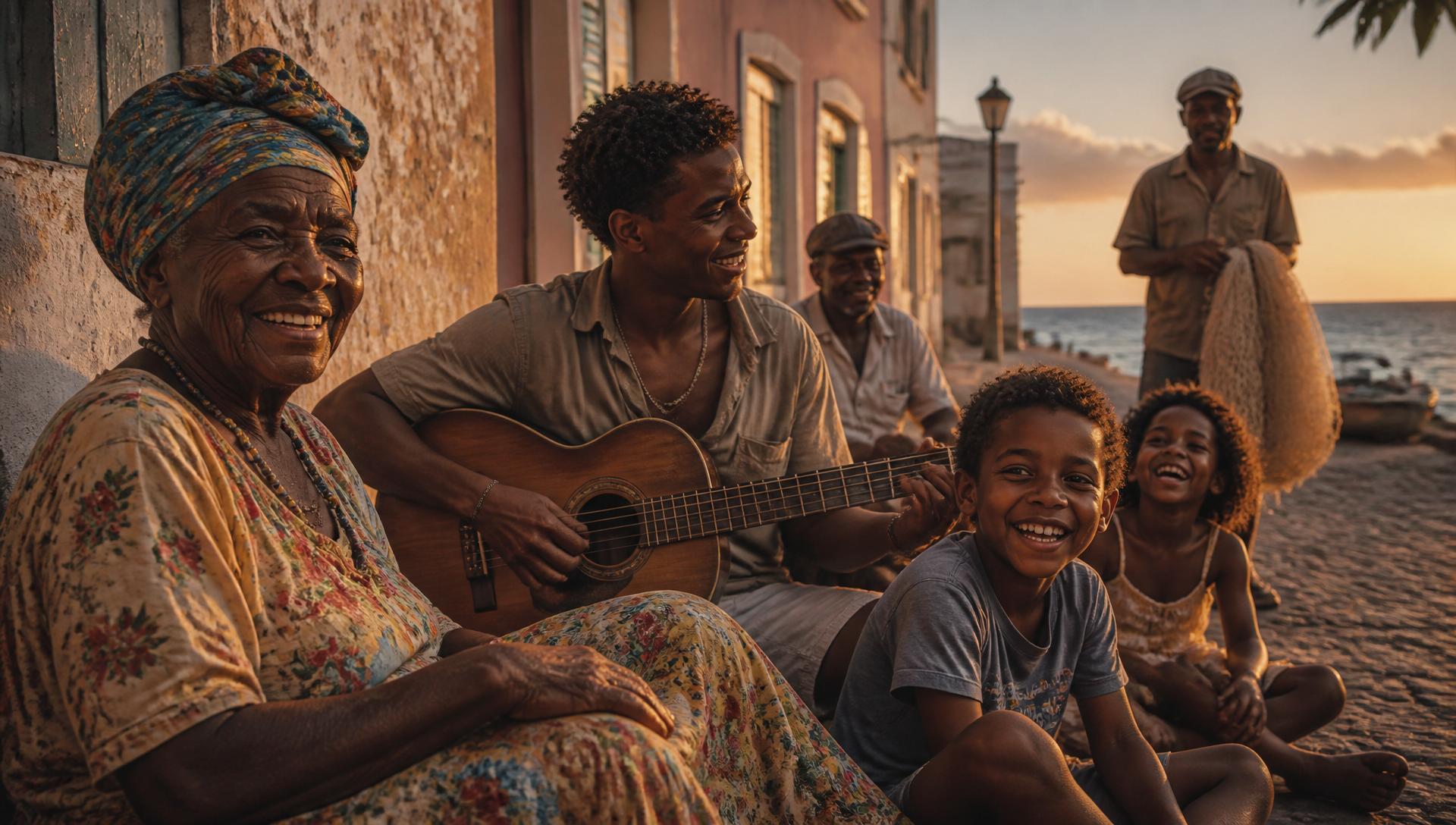
The people of Cabo Verde: how ten empty islands became a global Creole nation.
"Nôs identidade — it wasn't inherited. It was invented, generation by generation, out of everything the sea brought and everything the wind took away."
Most nations begin with a people who were already there. Cabo Verde begins with silence. When Portuguese caravels made landfall in 1456, the ten volcanic islands — flung 570 km off the coast of West Africa — had no human population at all. No footprints on the beaches. No smoke on the ridgelines. Just wind, seabirds, and the slow crack of basalt in the sun.
Everything that Cabo Verde is today — the language, the music, the morabeza, the diaspora — was built from scratch on those empty islands, in one of the most extraordinary cultural fusions in modern history.
The islands that made the people
Cabo Verde sits at a hinge in the Atlantic. Portuguese settlers arrived first, then — with the founding of Ribeira Grande on Santiago in 1462 — the archipelago became one of the earliest, and cruellest, hubs of the transatlantic slave trade. Enslaved people were brought from what is now Senegal, Guinea-Bissau, The Gambia, Sierra Leone and beyond, and held on the islands before being shipped onward to the Americas.
But some stayed. And in the mixing that followed — Portuguese with Mandinka, Fulani, Balanta, Wolof — a new people took shape. Not African. Not European. Cabo-verdiano. And with them, a language nobody else spoke: Kriolu, a Portuguese- based Creole that today has ten island dialects and is the mother tongue of every Cape Verdean, from Praia to Providence.
The islands themselves shaped the character. Volcanic Fogo taught resilience. Windswept Sal taught patience. Green Santo Antão taught the value of a single stream in a stone valley. And recurring droughts — the great famines of the 1770s, the 1940s — taught a lesson that never fully left: the sea can save you, or it can send you away.
The diaspora — larger than the homeland
There are roughly 500,000 people living in Cabo Verde today. There are more than 1.5 million living outside it. The diaspora is three times the size of the country.
The routes tell the story. New Bedford and Providence took the whalers of the 1800s — Cape Verdeans crewed American whaling ships when almost no other Black immigrants were allowed into the country. Boston and Brockton took the next wave in the 20th century, and today greater New England is home to the largest Cape Verdean community anywhere outside the islands. Lisbon and Rotterdam took the workers of the 60s and 70s. Paris, Luxembourg, Dakar, Buenos Aires each took a chapter.
What's remarkable is that the culture didn't dilute — it multiplied. Cesária Évora sang morna in Paris and put a whole country on the world's stereo. Cape Verdean-Americans became mayors, congresspeople, NBA players, poets. The funaná you hear in a basement party in Dorchester is closer, in some ways, to the funaná of São Vicente than either is to what your algorithm calls "Afrobeats."
Independence, and the fifty quiet years
Cabo Verde won independence from Portugal on July 5, 1975, and then did something almost no newly independent African nation of that era managed: it stayed stable. Fifty years of peaceful, uninterrupted democracy. Free press. Rotating governments. No coups. It is consistently rated one of the freest, safest, and least corrupt countries on the African continent.
That stability isn't glamorous, but it is the quiet foundation everything else is built on — the tourism, the music exports, the World Cup team, the fact that a grandmother in Mindelo can send her granddaughter to study abroad and reasonably expect her to come home.
What's next for the culture
A generation of young Cape Verdeans — half of them raised between two countries, fluent in Kriolu and English and Portuguese and TikTok — is now doing something new. They're not choosing between the island and the diaspora. They're routing between them.
You can hear it in the music: producers in Praia sampling batuku over trap drums; Cape Verdean-Portuguese rappers going platinum in Lisbon; kizomba nights selling out warehouses in Brooklyn. You can see it in the food: young chefs on Santiago reinterpreting cachupa — the national stew — as tasting menus without losing a gram of the soul. You can feel it in the tourism: for the first time, meaningful numbers of American travelers are choosing Cabo Verde because of the culture, not despite it.
The World Cup moment wasn't the beginning of any of this. It was the world finally catching up. A 570-year-old improvised nation, born on empty islands and scattered across four continents, is about to become one of the defining small cultures of this century — quietly, warmly, on its own terms.
As one Mindelo musician told a visiting journalist last year, when asked what he wanted the world to understand:
"We're not waiting to be discovered. We've been here. Come see."
Plan the trip the culture deserves.
The free US Traveler's Guide + Island CheatSheet covers flights, islands, budget, and how to meet the real Cabo Verde — not just the resort version.
Get the free guide →Meet Cabo Verde with a local
Walking tours, music nights, and hands-on experiences led by people who live here.
As a CaboBound partner, we may earn a small commission if you book through these links — at no extra cost to you.